
HAJJ - Journey to Allah's House
Here’s what you’ll do in the days of Hajj – 8th Dhul Hijjah to 13th Dhul Hijjah:

8th Dhul Hijjah
Today is the first day of Hajj!
You are back in your Ihram, reciting the Talbiyah as much as you can. Today, pilgrims travel to a place called Mina — a small valley close to Masjid al Haram.
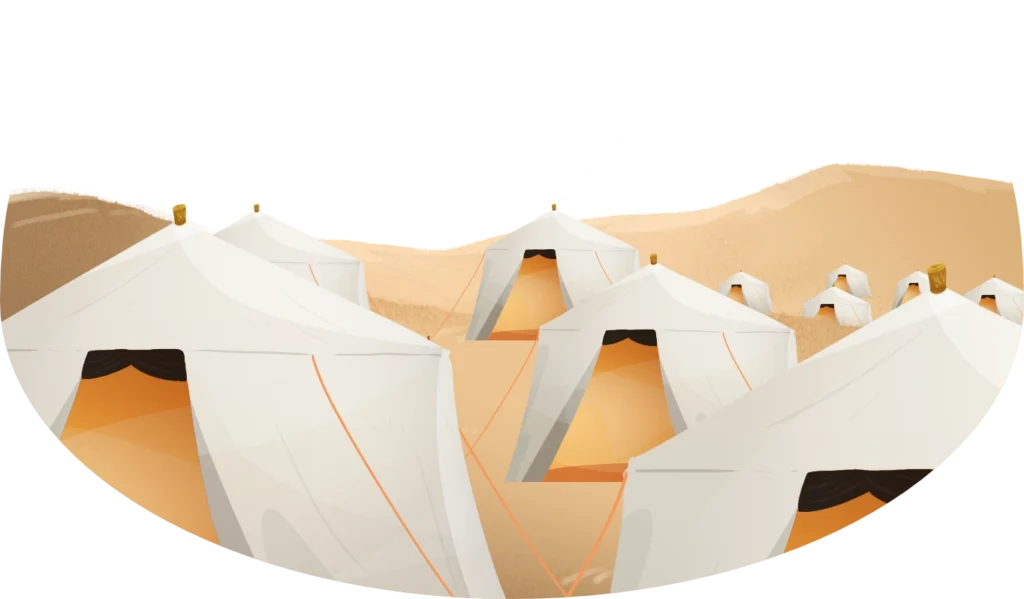
Everywhere you look, all you can see are rows and rows of white tents.
This is why Mina is also known as the City of Tents.
Mina is a very special place. Long ago, many prophets stayed here and worshiped Allah.
JUST IMAGINE
You are praying in the same place where noble prophets prayed thousands of years ago. What an amazing blessing!
A Special Salah Rule:
While in Mina, pilgrims follow a special salah rule. All four unit salah prayed here are shortened. This is called ‘Qasr’. When Muslims pray this way they show their willingness to obey Allah and please Him.
Spend your time remembering Allah, reciting the Quran and asking Allah to make Hajj easy for you.
And make sure you get plenty of rest!
Because what comes next is the biggest day of Hajj!
You’ll stay overnight in your tent and leave the next morning after Fajr.
9th Dhul Hijjah
After fajr on 9th Dhul Hijjah, the second day of Hajj, pilgrims leave Mina.
You are heading to a vast, open plain called ‘Arafah, surrounded by mountains.
On the way, you join thousands around you in whispering beautiful words of worship: taught to us by Prophet Muhammad (Peace be upon him)
“Allah hu Akbar.”
“La ilaha illallah.”
“Labbaik Allah Humma Labbaik.”
The Heart of Hajj:
Can you imagine a car without an engine? Or a human body without a heart?
Just like that, a Hajj without the Day of ‘Arafah is incomplete.
This is the most important day of Hajj.
Prophet Muhammad (Peace be upon him) said, “Hajj is ‘Arafah.” [Sunan al-Nasai: 3016]
A Day of Forgiveness:
Prophet Muhammad (peace be upon him) said: “There is no day on which Allah frees more people from the Fire than the Day of ‘Arafah.” [Sahih Muslim: 1348]
On this day, Allah looks at the people gathered in ‘Arafah and is so pleased with them that He boasts about them to the angels!
Millions of people — rich and poor, old and young, from every corner of the world — have gathered here. All equal. All hoping for Allah’s forgiveness.
And you are one of them!
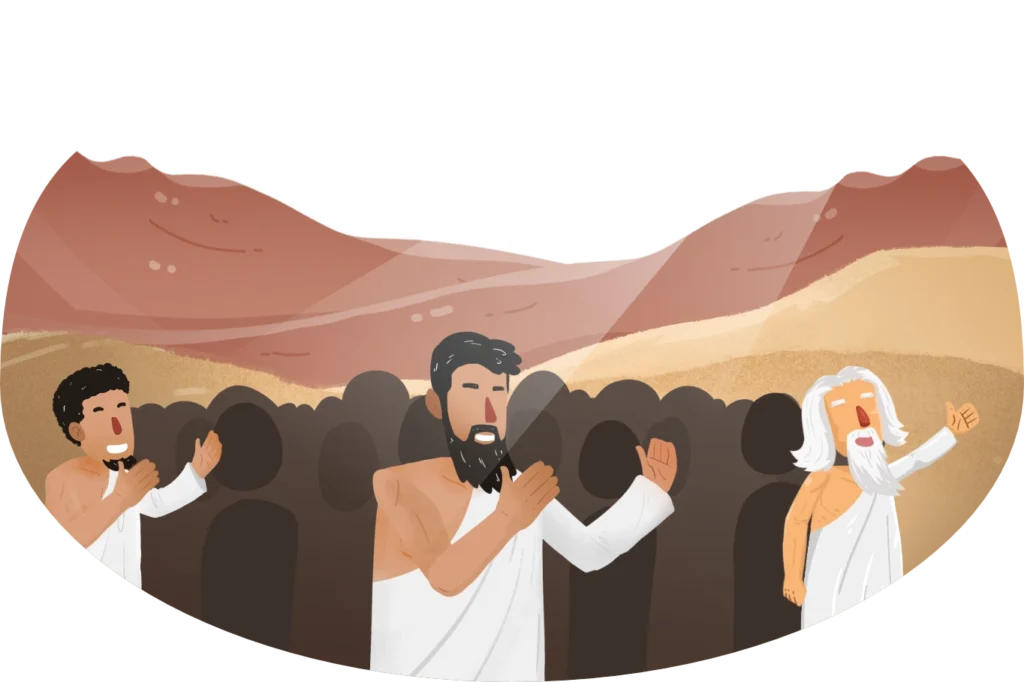
Prophet Muhammad’s (Peace be upon him) Farewell Sermon:
The Day of ‘Arafah is also remembered for another very important event.
It was on this day that Prophet Muhammad (Peace be upon him) gave one of his most important speeches when he performed his first and only Hajj.
This speech is known as the Farewell Sermon.
Prophet Muhammad (Peace be upon him) instructed people to worship Allah alone. He reminded them to be kind, and to treat each other with fairness and respect.
Make du'a:
Spend this day making du’a, especially from noon till sunset. You can worship and make du’a while standing in your tents, out under the open sky or even go to Jabal al Rahmah (The Mount of Rahmah).
A special Hajj sermon is delivered in Masjid Nimrah on this day. If you are able to hear it, listen carefully.
The Prophet ﷺ taught us the most powerful words to say on ‘Arafah:
“The best supplication is the supplication on the Day of ‘Arafah, and the best of what I and the prophets before me have said is:
لا إله إلا الله وحدهُ لا شريك لهُ، لهُ الملكُ ولهُ الحمدُ، وهو على كل شيءٍ قدير
‘There is no deity except Allah, alone, without partner. To Him belongs all dominion and praise, and He is over all things competent.’” [Tirmidhi: 3585]
A special blessing for everyone:
Did you know the Day of ‘Arafah is not just for the pilgrims?
Muslims all over the world can make the most of its blessings by making du’a and asking Allah for forgiveness.
It is also recommended for those not performing Hajj to fast on the Day of ‘Arafah. Allah forgives their mistakes and blesses them with great rewards.

The Night of 10th Dhul Hijjah
Off to Muzdalifah!
After the sun sets on the 9th of Dhul Hijjah, you will move to your next stop – Muzdalifah. It is an open area between ‘Arafah and Mina. This is where you will spend the night, and leave the next morning after sunrise. It is a time for worship and rest.
Under the open sky:
Did you know that unlike Mina there are no tents in Muzdalifah? Millions of pilgrims sleep out in the open – on mats, on the roadside, wherever they can find a spot!
It’s crowded. It’s noisy. And it’s nothing like your cosy bed at home. And you’re so tired!
But here’s the thing — none of that matters. Because everyone around you is there for the same reason. For Allah. And that fills your heart with peace.
An Important Task:
An important task has to be done in Muzdalifah. You will collect small pebbles, about the size of chickpeas. This is a preparation for a ritual that will be performed in the morning, called Rami. Keep them safe!

PEBBLE MATH
Here’s a little challenge before you sleep!
You need 7 pebbles for each pillar you stone in Rami
On the 10th of Dhul Hijjah, you stone just one pillar — 7 pebbles. On the 11th, 12th and 13th, you stone all three pillars each day. But staying till 13th is optional. Most people leave on the 12th.
How many total pebbles will YOU need if you’re leaving on the 12th?
Your uncle is staying for the extra optional day on the 13th too. How many will he need?
The Day of 10th Dhul Hijjah
A very busy and blessed day lies ahead – the day of Eid al Adha and Sacrifice!
Many great deeds have to be done today. Every moment is precious and full of reward.
On the morning of 10th of Dhul Hijjah, pilgrims pray the Fajr salah as early as possible. After this, they stand in worship, remembering Allah and making du’a. Then, after sunrise, it is time to begin the journey back to Mina.
A special instruction!
As you travel back to Mina, you will come across the Valley of Muhassar on the way. Prophet Muhammad (Peace be upon him) instructed pilgrims to hurry to cross the valley.
DO YOU KNOW WHY?
This valley is connected to the story of Abraha’s army. He was a king who came towards Makkah with an army that wanted to harm the Ka’bah.
But Allah protected His House and sent flocks of birds carrying small stones. The army was stopped and destroyed before they could even reach the Ka’bah! You can watch the complete story here.

1. The First Ritual - Rami of Jamarah al Aqabah:
The whispers of the Talbiyah – “Labbaik Allah Humma Labbaik,” continue to echo in the air as pilgrims prepare to perform the first ritual of the day.
Remember the pebbles you had collected from Muzdalifah? The time has come to use them.
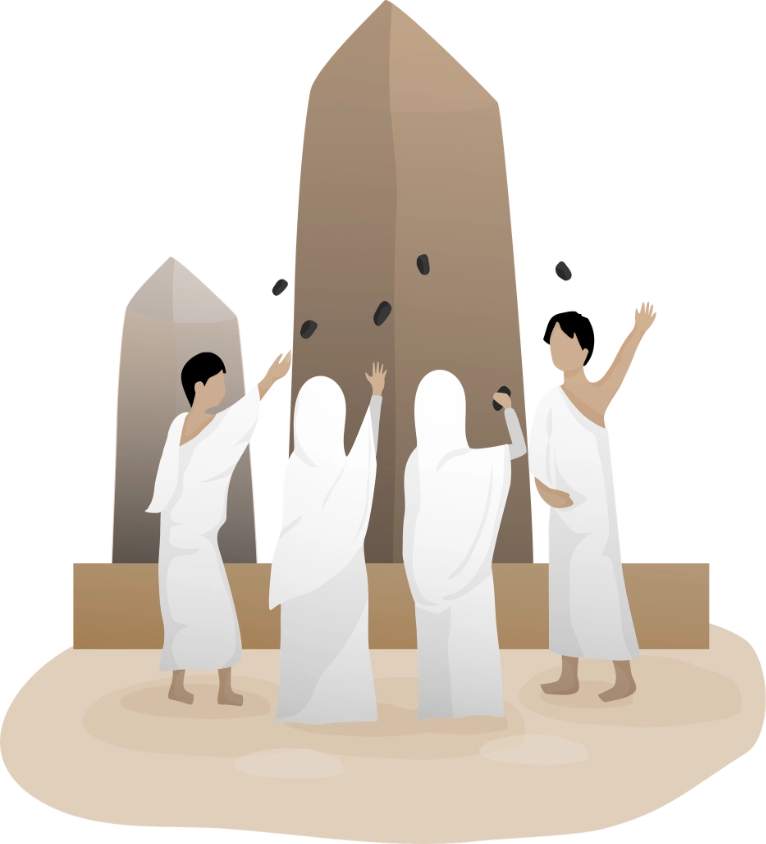
You will go to the area of the Jamarat – the three stone pillars. On this day, only the largest pillar is stoned — the Jamarah al Aqabah. You throw seven small pebbles at it, one by one. Each time saying: Allahu Akbar! Allah is the Greatest!
These pillars mark the very spots where Shaytan appeared to Prophet Ibrahim (peace be upon him) and tried to stop him from obeying Allah. Ibrahim drove him away by throwing stones.
By following in his footsteps, we show Allah that we too choose obedience over the whispers of Shaytan.
WHY DO WE DO THIS?
Like the other rituals of Hajj, Rami is also a way to show obedience of Allah and His commands. We stone the pillars because Allah asked us to do so.
2. The Second Ritual - The Sacrifice:
After Rami, pilgrims move to the second important ritual of the day, the sacrifice of an animal.
An Extraordinary Sacrifice:
This ritual reminds us of Prophet Ibrahim (Peace be upon him).
He was tested by Allah by a dream in which he was asked to sacrifice what he loved most – his son, Prophet Ismail (Peace be upon him).
Both father and son were ready to obey Allah. Because of their sincere faith, Allah showed His mercy. The sacrifice was replaced by a ram.
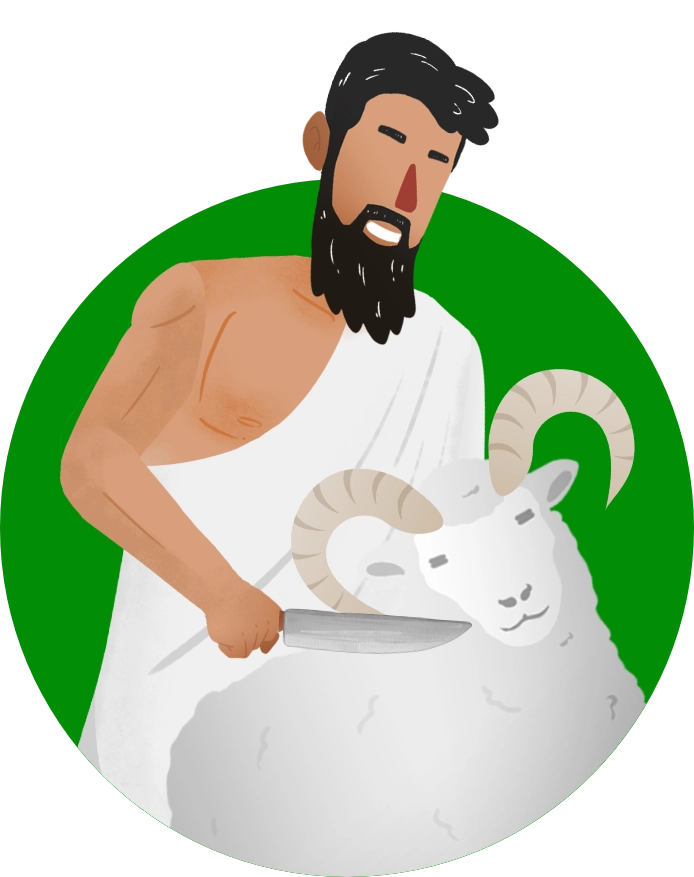
Every year on the 10th of Dhul Hijjah, Muslims all over the world celebrate Eid al Adha by sacrificing a camel, goat, cow or sheep in memory of this extraordinary event.
Sacrifice for pilgrims and leaving the state of Ihram:
As a pilgrim, you do not need to perform this important step yourself. The government of Saudi Arabia arranges the sacrifice to be done on behalf of the pilgrims to make things easy.
As soon as you are notified that your sacrifice has been completed, you can prepare to leave the state of Ihram. Men get their hair shaved while women bundle up their hair and get it trimmed up to the length of a fingertip.
Now you are allowed to take a shower, change clothes and apply perfume.
A Feast For Everyone!
The meat from the sacrificed animals is shared with people in need. This way, everyone gets a chance to be a part of the joy and celebration of Eid.
3. The Final Rituals - Tawaf al Ifadah (also known as Tawaf al Ziyarah) and Sa’ee:
Now pilgrims return to Masjid al Haram — back to the Ka’bah.
This time feels different though.
You have been patient. You have been tired. You have obeyed Allah even when it was hard. You are not the same person who first stood here.
As you circle the Ka’bah seven times, your heart fills with love for Prophet Ibrahim — the man who built it.
And as you walk between Safa and Marwah again, you feel Hagar’s story differently now. You lived a little of it yourself. Just like her, you didn’t give up even when you felt really, really tired.
With this, the 10th of Dhul Hijjah comes to an end. But your Hajj still has a few more important steps to go
11th, 12th and 13th of Dhul Hijjah
After completing Tawaf al Ifadah, you come back to Mina. Here you will spend the 11th, 12th and 13th Dhul Hijjah.
Stoning all three Jamarat:
On these three days pilgrims have to stone all the three pillars or the Jamarat, but in a specific order.
You will begin with the Jamarah al Ula (the small pillar), followed by the Jamarah al Wusta (the middle pillar) and finally the Jamarah al Aqabah (the large pillar).
The method remains the same, seven stones are thrown one by one at the pillars calmly, saying “Allah hu Akbar”.
The rest of the time is spent remembering Allah, reciting the Quran and making du’a.
This is the time to thank Allah for the incredible journey of Hajj, to ask Him to accept all good deeds and forgive any mistakes.
Leaving Mina:
After this, pilgrims leave Mina and return to Makkah. They may leave on the 12th or stay till the 13th of Dhul Hijjah. Allah has allowed both options.
Bidding Farewell to the House of Allah:
The time to say goodbye to the House of Allah has come.
Before leaving Makkah, pilgrims perform one final Tawaf around the Ka’bah. This is the Tawaf al Wida – the Farewell Tawaf.
Prophet Muhammad (Peace be upon him) advised that this should be the last act of Hajj before pilgrims return to their homes.
Alhumdulillah! You have successfully completed your Hajj!

Mixed Feelings:
You will feel many emotions at the same time.
You will feel relief and happiness that Allah gave you a chance to complete such an important pillar of your faith.
You will also be hopeful, praying that Allah accepts your worship.
At the same time, you will feel really sad to leave the most beautiful place on earth – the House of Allah.
With du’as to return again, and a heart full of love, you begin your journey home.
After this memorable, life changing journey, do you now feel like a new you?